Heat Pump vs Furnace in 2026: What Costs Less
Updated:
A heat pump costs less to run than a gas furnace only when your electricity-to-gas price ratio is favorable. At a coefficient of performance (COP) of 3 and the July 2026 US average of 18.31 cents/kWh, one therm of heat costs about $1.79 in electricity, so the heat pump wins if your gas costs more than about $1.70 per therm of delivered heat. The federal heat pump tax credit ended after Dec. 31, 2025.
Two numbers decide this question, and neither is the sticker price. The first is your local price per unit of heat from gas. The second is your local price per unit of heat from electricity. Everything else in this guide is context for those two lines on your utility bills.
This is an information piece built from government and standards-body sources, checked on Oct. 9, 2026. Installed prices come from vendor guides, so treat them as ranges, not quotes.
목차
- How does a heat pump make heat differently from a furnace?
- Do I need a separate air conditioner with a furnace?
- Which costs more to install?
- Which one is cheaper to run at my prices?
- Does a heat pump keep working below freezing?
- What does “sized right” mean for a heat pump?
- Is a dual-fuel setup worth it?
- Is the heat pump tax credit still available in 2026?
- What is the 95% furnace rule, and does it affect my choice?
- Is combustion a safety concern?
- Which setup fits my situation?
- What do people get wrong?
- What should I check before I sign a quote?
- FAQ
- Sources
How does a heat pump make heat differently from a furnace?
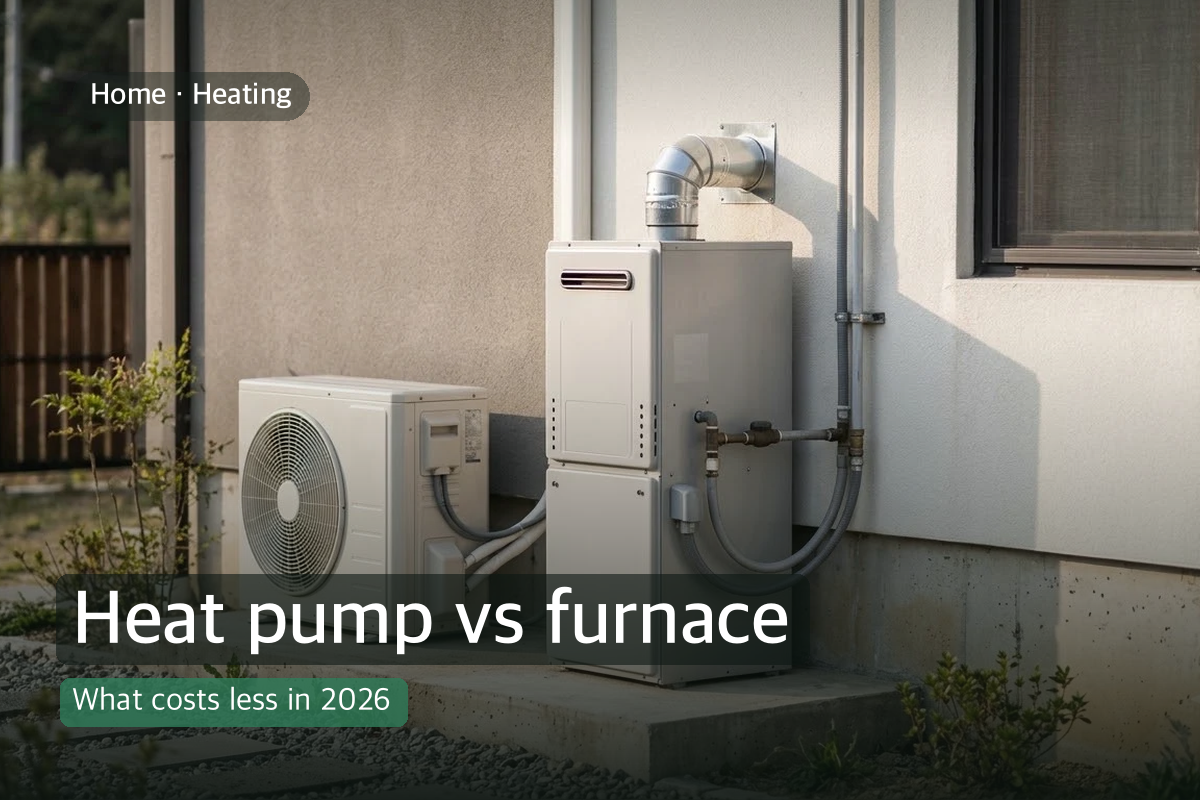
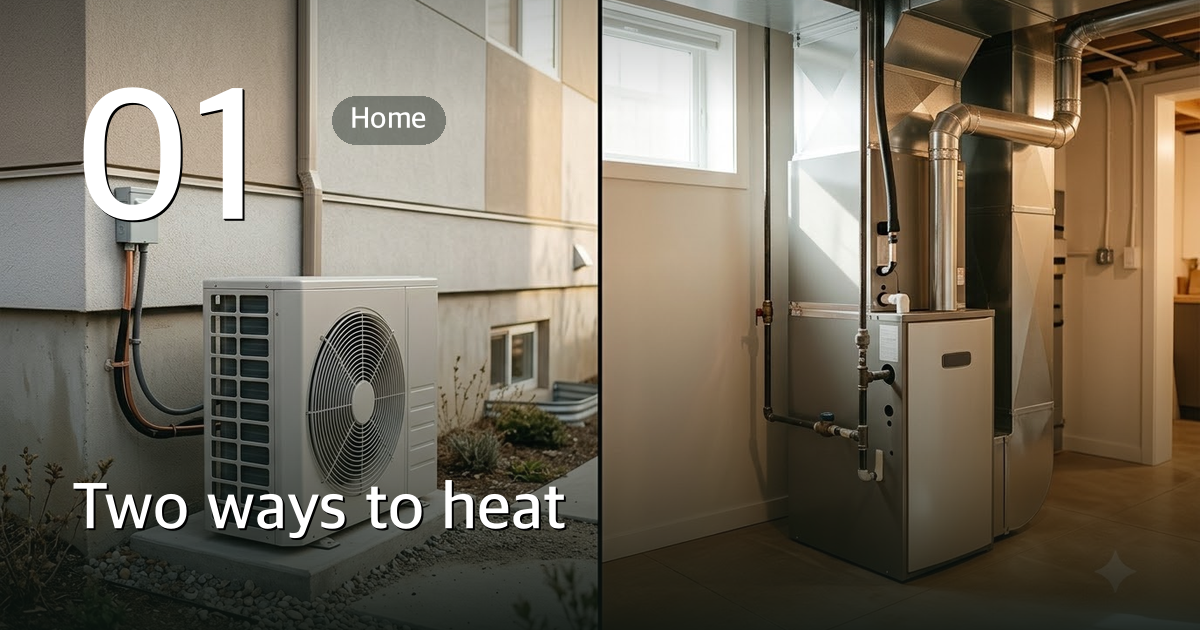
A furnace burns fuel (usually natural gas) and pushes the hot air through ducts. A heat pump uses electricity to move heat from one place to another, so it does not create heat by combustion. ENERGY STAR says a heat pump can deliver “up to three times more heat energy to a home than the electrical energy it consumes,” and that it is more efficient than a furnace or boiler “even during winter” (Source: ENERGY STAR, checked 2026-10-09).
That “three times” figure is the COP: heat out divided by electricity in. A gas furnace can never exceed 100% because it only converts fuel to heat. Efficiency ratings for furnaces use AFUE, so a 95% AFUE unit sends 95 cents of every fuel dollar’s heat into your house and loses the rest up the flue.
A heat pump also runs in reverse. A reversing valve lets the same outdoor coil and indoor coil cool the house in summer. That matters in the next section.
Do I need a separate air conditioner with a furnace?
Yes. A furnace only heats. If you want cooling you add central AC, which is a second piece of equipment with its own compressor and coil. A heat pump does both jobs.
That changes how you should compare prices. A fair comparison is “heat pump” against “furnace plus central AC,” not “heat pump” against “furnace alone.” One vendor guide puts a furnace plus central AC at about $9,000 to $17,000, while the same guide and another put a whole-home heat pump anywhere from $5,000 to $18,000, depending on ducts and region (Source: acdirect.com, jouleio.com; vendor ranges, not official).
If your AC is 12 years old and your furnace is 18, you are going to buy both soon. That is the cheapest moment to switch.
Which costs more to install?
Neither wins everywhere. The table below lays out the main options. Prices are vendor ranges because no official national average installed price turned up in research.
| Option | Rough installed cost | Main downside |
|---|---|---|
| Gas furnace, 80% AFUE (current federal floor) | $3,000-$7,000 (furnace only) | Combustion and flue risk; separate AC needed |
| Gas furnace, 95% AFUE condensing | Similar range, plus venting and condensate work | Still needs AC; exposed to gas prices |
| Standard air-source heat pump | $5,000-$15,000 in one guide; $12,000-$18,000 ducted in another | Capacity drops in deep cold; may lean on electric backup |
| Cold-climate heat pump | About $6,000-$12,000 in one estimate | Costs more than a standard unit; sizing matters |
| Dual fuel (heat pump plus existing furnace) | “A modest extra cost over an AC system” (ENERGY STAR) | Two systems to maintain |
The two vendor guides disagree with each other, which is the honest reason to get three written quotes. Ask each contractor to price the same scope, including duct repair.
Why the ranges are wide
Ducts, electrical panel upgrades, permits and local labor rates move a quote by thousands of dollars. A house with sealed, correctly sized ducts is at the low end.
Which one is cheaper to run at my prices?
The answer depends on your ratio of electricity to gas prices. Here is the unit math, using standard conversions.
One therm is 100,000 BTU, which equals about 29.3 kWh of heat. At COP 3, delivering one therm of heat takes about 9.8 kWh of electricity. At the EIA’s July 2026 national residential average of 18.31 cents/kWh, that is about $1.79 (Source: EIA Electric Power Monthly, July 2026 data; calculation is ours).
A 95% AFUE furnace needs 1/0.95 therm of gas for each therm of heat. So the heat pump breaks even when your gas costs about $1.70 per therm ($1.79 × 0.95) at COP 3.
COP changes with outdoor temperature, so run the same formula at three values:
| Heat pump COP | Electricity per therm of heat | Cost at 18.31¢/kWh | Break-even gas price (95% furnace) |
|---|---|---|---|
| 2 | about 14.7 kWh | about $2.68 | about $2.55/therm |
| 3 | about 9.8 kWh | about $1.79 | about $1.70/therm |
| 4 | about 7.3 kWh | about $1.34 | about $1.27/therm |
(All values are our calculations, rounded.)
The gas price is where people get stuck. EIA publishes residential gas in dollars per thousand cubic feet: $26.45 per Mcf in July 2026. Summer prices look high because fixed charges are spread over very little use, so do not convert that number to a winter cost (Source: EIA, July 2026). Read your own winter bill instead. Divide the gas charge by the therms used, and divide the electricity charge by kWh.
Check your own bills
Pull your last January gas bill and your last January electric bill. Gas cost per therm and electricity cost per kWh are both printed on most utility statements. Plug them into the table above.

Does a heat pump keep working below freezing?
Yes, down to a point, and the point has a spec. ENERGY STAR certifies cold-climate heat pumps by testing them down to 5°F. To qualify, a unit needs a COP of at least 1.75 at 5°F and a heating capacity at 5°F of at least 70% of its capacity at 47°F. Ducted split systems need at least 8.1 HSPF2, non-ducted splits at least 8.5 HSPF2, and all need 15.2 SEER2 or better (Source: ENERGY STAR key product criteria).
Standard (non-cold-climate) units must reach 7.8 HSPF2 for split systems and 7.2 HSPF2 for single-package systems. ENERGY STAR notes that units keep working below 5°F, but a backup heat source is most efficient at very low temperatures.
Lab and field data point the same way. An Oak Ridge National Laboratory field study of a cold-climate prototype in an Ohio home recorded a seasonal COP of 3.16 and ran down to -13°F without resistance heat. That was a prototype, not a retail product, so it shows what is possible, not what your installer will hand you (Source: ORNL via OSTI).
The NEEP cold-climate specification, version 3.1 (effective Aug. 1, 2021), targets IECC climate zone 4 and colder, and requires a variable-capacity compressor with three or more speeds or continuously variable output.
Performance still falls as the air gets colder. Sizing and controls matter, which brings us to the next section.
What does “sized right” mean for a heat pump?
ENERGY STAR says the contractor should use a Manual J load calculation to size the unit. That is a room-by-room calculation of how much heat your house loses at your design temperature.
A contractor who sizes by square footage alone, or by “what the old unit was,” is guessing. An oversized furnace short-cycles. An undersized heat pump leans on electric resistance backup, which has a COP of 1 and wipes out the savings.
Ask each bidder for the Manual J report. If a contractor will not show the numbers, that is your answer.
Is a dual-fuel setup worth it?
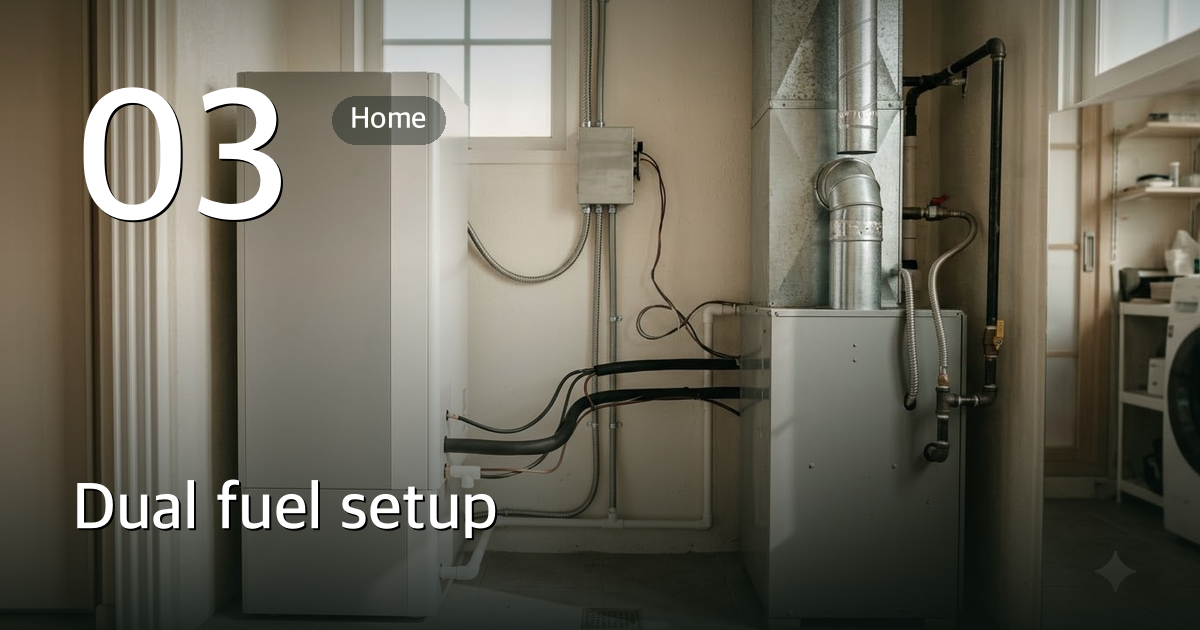
Dual fuel means a heat pump plus your existing gas furnace. The heat pump handles most of the season. The furnace takes over when it gets cold enough that gas is cheaper per unit of heat, or when the heat pump would otherwise need resistance backup.
ENERGY STAR describes the added cost as “a modest extra cost over an AC system” if you are replacing your air conditioner anyway. That is the key condition. If your furnace is healthy and the AC is dying, you buy a heat pump instead of a new AC and keep the furnace as backup.
The trade-off is two systems to maintain, and one set of controls that has to be set up correctly.
Is the heat pump tax credit still available in 2026?
No. The IRS Energy Efficient Home Improvement Credit was 30% of qualified costs, capped at $2,000 per year for heat pumps, and the property had to be placed in service before Dec. 31, 2025. The IRS page was last reviewed April 28, 2026 (Source: IRS, checked 2026-10-09).
ENERGY STAR’s heat pump page still lists the “up to $2,000” credit through 2032. That conflicts with the IRS page. This guide follows the IRS date, because the IRS administers the credit.
What remains is rebate money. DOE’s home energy rebate programs offer up to $8,000 toward a heat pump for households under 80% of area median income, and up to $4,000 for households at 80% to 150%. DOE’s June 2026 factsheet said 12 states plus Washington, D.C. had launched programs, and California’s single-family funds were fully reserved as of Feb. 24, 2026 (Source: DOE state home energy rebates factsheet, June 2026).
Check your state energy office and your electric utility. Programs vary and run out of funds.
Old articles lie about this
A page that promises $2,000 back on a 2026 install is out of date or is summarizing the old rule. Confirm the in-service date and the program with the source, not the blog.
What is the 95% furnace rule, and does it affect my choice?
DOE finalized a 95% AFUE standard for non-weatherized gas furnaces and mobile-home gas furnaces on Sept. 29, 2023, with compliance in late 2028. The current floor is 80% AFUE. DOE estimated $1.5 billion in annual utility savings (Source: DOE).
The rule is tied up in court. The D.C. Circuit upheld it in November 2025. A trade-press report says the Supreme Court vacated that ruling on June 8 and sent the case back for reconsideration, and that the rule is reported to remain in effect during the remand. Treat the status as unsettled (Source: Contracting Business).
For you this changes one practical thing. If you install a new gas furnace today, an 80% unit is still legal, but a 95% condensing furnace is the safer bet for resale and future rules. It also needs venting and condensate drainage, which adds cost.
Is combustion a safety concern?
It can be. EPA says worn or poorly maintained combustion devices, such as furnaces and boilers, or blocked or leaking flues, can be significant sources of carbon monoxide (Source: EPA indoor air quality page; archived 2021 snapshot).
Heat pumps produce no direct combustion emissions, meaning no NOx, CO2 or carbon monoxide at the unit (Source: ENERGY STAR). If you keep a gas furnace, put a carbon monoxide alarm on each level and have the flue and heat exchanger inspected annually.
Which setup fits my situation?
- You have a working furnace and a dying AC. Price a heat pump as a dual-fuel setup. The extra cost over a plain AC is the number to compare.
- You heat with electric resistance. ENERGY STAR’s factsheet figure is about $460 a year in average savings from switching to a heat pump. Heat pumps pay back fastest here. (Search summary of the factsheet; confirm on the PDF.)
- You heat with oil. Same factsheet: about $950 a year in average savings.
- You have no gas line. A heat pump avoids the cost of trenching a gas line, and propane or oil is usually the most expensive heat you can buy per unit.
- You live in zones 6 or 7. Ask for a cold-climate model that meets the ENERGY STAR cold-climate criteria and plan for a backup. The 5°F test point is a floor, not a ceiling, and sizing at your design temperature decides everything.
- You have cheap gas and no AC. A 95% furnace may stay cheaper to run. Run the break-even math with your own bills first.
What do people get wrong?
Three claims show up in many guides.
“Heat pumps don’t work below freezing.” Certified cold-climate units are tested to 5°F with a COP of at least 1.75. Capacity still declines, and a poorly sized unit will struggle.
“The federal tax credit still pays $2,000.” It ended for property placed in service after Dec. 31, 2025. Some pages still list it.
“A 300% efficiency means three times cheaper.” COP 3 means three units of heat per unit of electricity. Electricity usually costs more per unit of energy than gas, so the saving depends on the price ratio you calculated above.
What should I check before I sign a quote?
- Manual J load calculation attached to the quote
- Model number and HSPF2, SEER2 and COP at 5°F listed
- ENERGY STAR cold-climate certification if you live in zone 5 or colder
- Duct inspection and any sealing or repair scope priced separately
- Backup heat type stated (electric strip, gas furnace, none)
- Rebates your contractor says apply, with the program name
- Your winter gas and electric rates, run through the break-even table

Bring the checklist to each bidder and compare the same lines side by side.
FAQ
Is a heat pump cheaper than a gas furnace to run?
It depends on local prices. At COP 3 and 18.31 cents/kWh (EIA, July 2026), heat from a heat pump costs about $1.79 per therm, so it beats a 95% furnace when gas is above about $1.70 per therm. Use your winter bills for the real comparison.
Can a heat pump heat a house when it is below 0°F?
Some can. ENERGY STAR cold-climate units are certified to 5°F, and ORNL ran a prototype at -13°F without resistance heat. For retail units, expect lower capacity at those temperatures and plan for a backup.
Can I use my existing ducts with a heat pump?
Often yes, if the ducts are sealed and sized for the airflow. ENERGY STAR lists ducted split systems among certified types, and a Manual J calculation plus a duct inspection tell you whether yours qualify.
Is there still a federal tax credit for heat pumps?
No for installs placed in service after Dec. 31, 2025 (IRS). DOE-funded state rebates of up to $8,000 or $4,000, based on income, may still be available where programs have launched.
Will I be forced to buy a 95% AFUE furnace?
Not yet. DOE’s rule has a late-2028 compliance date, but litigation is unsettled, and the current floor is 80% AFUE.
Sources
- ENERGY STAR: Air Source Heat Pumps (checked 2026-10-09)
- ENERGY STAR: Air Source Heat Pumps key product criteria (checked 2026-10-09)
- IRS: Energy Efficient Home Improvement Credit (checked 2026-10-09)
- EIA: Electric Power Monthly, average price by sector (checked 2026-10-09)
- EIA: US residential natural gas price (checked 2026-10-09)
- DOE: 95% AFUE furnace standard (checked 2026-10-09)
- Contracting Business: Supreme Court vacates ruling on furnace standard (checked 2026-10-09)
- ORNL cold-climate heat pump field study (OSTI) (checked 2026-10-09)
- DOE state home energy rebates factsheet, June 2026 (checked 2026-10-09)
- NEEP cold-climate air-source heat pump specification v3.1 (checked 2026-10-09)
- EPA: What is carbon monoxide (2021 snapshot) (checked 2026-10-09)